
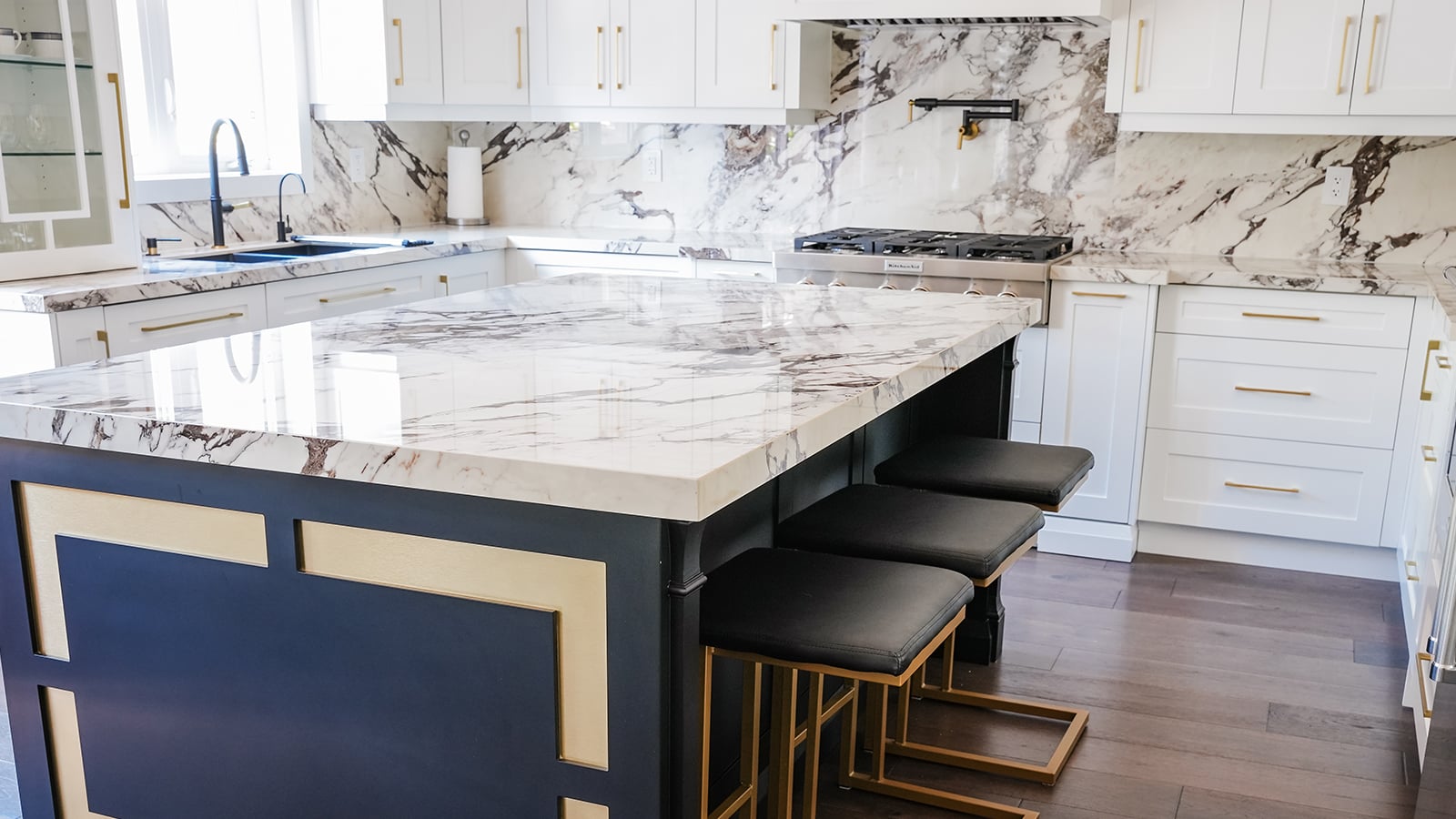
Half the kitchens we measure in Mississauga do not need new cabinets. They need new doors, drawer fronts, hinges and a countertop — and a contractor willing to say so. The other half genuinely need replacing, and refacing them would be money spent twice. This guide gives you the checks we run on the measure visit so you can run them yourself first.
What refacing actually is
Refacing keeps your existing cabinet boxes — the carcasses screwed to the wall and floor — and replaces everything you see and touch: doors, drawer fronts, hinges, drawer runners and handles. The exposed sides and toe kicks are skinned with a matching material. Usually the countertop is replaced at the same time, because a new door style against a tired laminate top looks like exactly what it is.
Done properly, refacing is not a paint job. The doors are new, made to the exact sizes of your openings in the workshop, and the hardware is new. What you keep is the box and the layout.
The ten-minute inspection
Take a flashlight and open every cabinet.
- Under the sink. Press the floor of the cabinet with your thumb. Particleboard that has swollen, flaked or gone soft from a leak has to go. One damaged box can be replaced individually; a run of them means a new kitchen.
- The back wall. Pull a drawer out and look at where the box meets the wall. Boxes that have pulled away, racked out of square or sag at the hanging rail will never take new doors straight.
- The hinges’ home. Doors can be re-drilled, but a box side that has split around the old hinge holes is a problem that follows every new door you hang.
- The corners. Check how the lazy-Susan or blind corner works. If you hate it now, refacing keeps it exactly as it is.
- The drawers. Old side-mount runners can be swapped for full-extension soft-close runners on sound boxes. If the drawer boxes themselves are falling apart, that is a replacement of the drawer boxes, which is still refacing.
- The layout. Stand where you cook. If the dishwasher is across the room from the sink, the fridge door hits the island, or there is one drawer for a family of five, no door style fixes that.
Sound boxes plus a layout you can live with: reface. Damage, sag or a layout that fights you: replace.
What each one costs, relative to the other
We publish our own ranges once confirmed in writing by the operator [TBC]; the relationship between the two options is stable enough to describe now. Refacing is typically a fraction of replacement because you are buying doors, fronts, hardware and the installation labour rather than boxes, demolition, disposal, a possible permit and a fresh countertop template. The published Mississauga cost guide puts a 2026 same-footprint replacement around the $30,000 mark for a detached home; a refresh of a sound kitchen lands well under that. Once boxes need repair, or you decide to move the sink while you are at it, the gap closes quickly and replacing is the better spend.
Where refacing goes wrong
- Refacing boxes that are already failing. The new doors look good for a season; the hinges pull out the next.
- Peel-and-stick veneers. Thin films on the box sides lift at the edges near the dishwasher and stove. We skin with rigid material.
- Ignoring the countertop. A new face above an old top rarely satisfies anyone.
- Keeping bad hardware. New doors on old hinges close like old doors.
Where replacing goes wrong
- Replacing sound boxes for a look. If you only want a different door, you are paying for demolition you do not need.
- Changing the layout without a permit. Relocating the sink or altering drainage in Mississauga needs a City building permit, and new circuits need an ESA electrical permit; the contractor should raise both, not you.
- Ordering before the design is final. Nothing should be cut until the 3D drawing is signed off.
How Prime Kitchen and Bath decides
We run the inspection above on the measure visit and tell you which project you have, including when the answer is “leave the boxes, change the doors, spend the difference on the countertop”. Both routes are built in the same Sismet Road workshop and installed by the same crew. Ask us to look at your kitchen, or see what a full renovation involves if you already know the boxes have to go.
Frequently asked questions
Is it cheaper to reface or replace kitchen cabinets?
Refacing is cheaper when the existing boxes are sound, because you are buying doors, fronts, hardware and labour rather than boxes, demolition, disposal and a new countertop template. Once boxes need repair or the layout changes, the gap closes fast and replacing usually wins.
How long does cabinet refacing take?
Doors and fronts are made in the workshop to your opening sizes, then installed in a short visit with the kitchen usable throughout. Typical durations are published once the operator confirms them.
Can you reface and change the layout?
No — refacing keeps the boxes where they are. If you want an island, a pantry run or the sink moved, that is a replacement project.
Not sure? We check the boxes honestly on the measure visit.
Get a written, itemised quote with a 3D design — no obligation.
Ask us which one your kitchen needs