
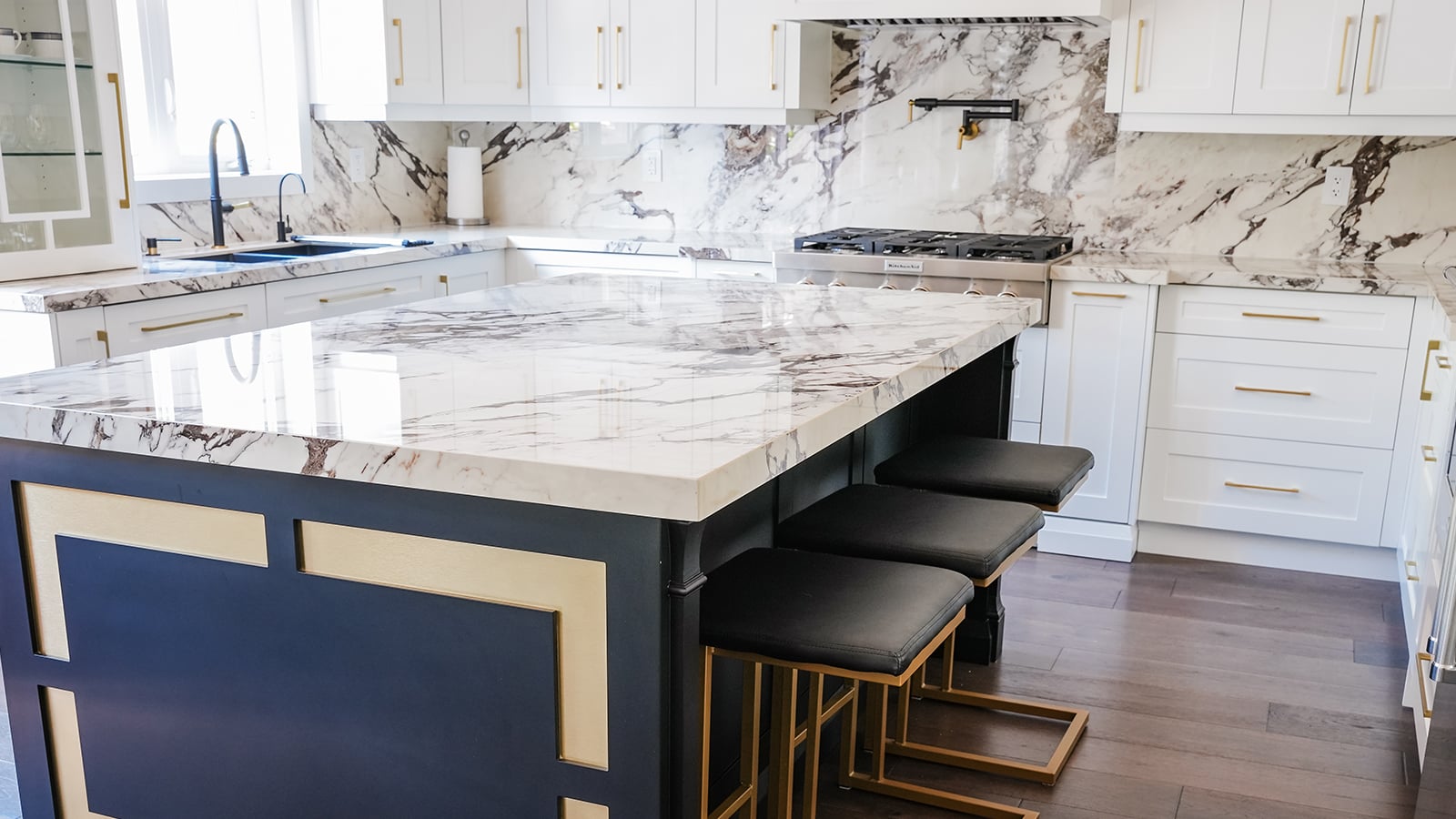
Countertops are the surface you touch most, the second-largest finishing line on a kitchen quote after the cabinets, and the decision people most often make from a showroom sample instead of from the way they cook. This guide compares the three materials we install most in Mississauga — quartz, granite and porcelain — on the things that matter at 6 p.m. on a weeknight: heat, stains, chips, seams, cleaning and cost.
Quartz: the predictable one
Quartz countertops are engineered — mostly ground natural quartz bound in resin with pigments — which is why the pattern you see on the sample is the pattern you get on the slab. The surface is non-porous, so wine, coffee, turmeric and oil wipe off without sealing, ever. It is the default choice in Mississauga family kitchens for exactly that reason.
The weakness is heat. The resin can scorch, yellow or crack under a pan straight from the burner, and the damage is permanent. Quartz also does not love direct, constant sunlight on the brightest whites. Edge chips are rare but, when they happen, hard to repair invisibly. Fabrication is routine and priced predictably, which keeps quotes comparable between contractors.
Choose quartz if: you want a consistent look, hate maintenance, and will use a trivet.
Granite: the one with character
Granite is natural stone, cut from a quarried block, so every slab is different — the reason some people love it and the reason you should pick the actual slab, not the sample. It shrugs off heat, resists scratches, and at entry grades competes with mid-range quartz on price. Premium and exotic granites go well beyond.
The trade-offs: granite is porous to varying degrees and most varieties want sealing periodically, though modern sealers make this a once-every-few-years job rather than an annual chore. Lighter granites can stain from oil if left. Seams are harder to hide because the pattern does not repeat. Chips at edges can usually be repaired with a colour-matched epoxy.
Choose granite if: you cook hot and hard, want natural variation, and will pick your slab in person.
Porcelain: the new one
Porcelain (sintered stone) countertops are made from fired clay and minerals in large, thin slabs — often 12 mm compared with 20 or 30 mm for quartz and granite. They handle heat, UV and scratches better than either, do not stain, and allow very thin profiles and seamless wraps onto a waterfall end or backsplash. Full-slab porcelain also works outdoors.
The known weakness is edge chipping, because the material is hard and thin; the edge profile and how the slab is handled during fabrication matter more than with any other material. Fabrication needs specialist tooling and experience, so it costs more to cut and install even when the slab itself is mid-priced, and not every shop does it well. Choose your fabricator for porcelain more carefully than you choose the colour.
Choose porcelain if: you want heat and UV resistance, a thin modern profile, or an outdoor kitchen, and you have a fabricator who does it regularly.
The side-by-side
| Quartz | Granite | Porcelain | |
|---|---|---|---|
| Heat | Poor — use trivets | Excellent | Excellent |
| Stains | Excellent, no sealing | Good with sealing | Excellent |
| Scratches | Good | Very good | Excellent |
| Edge chips | Rare, hard to repair | Repairable | The known weakness |
| Pattern | Consistent, matches sample | Unique per slab | Printed, consistent |
| Seams | Easy to hide | Harder on busy patterns | Easy on plain, harder on veined |
| Outdoor / UV | Not recommended | Fine | Fine |
| Fabrication cost | Standard | Standard | Higher |
What the fabrication adds
The slab is only part of the price. Seam count, sink cut-outs (undermount costs more than drop-in), a cooktop cut-out, the edge profile, a waterfall end and a full-height backsplash are all fabrication hours. On the quote these should appear as their own lines, so you can see what a mitred edge or a second seam-free island slab is actually costing. Our Mississauga cost guide puts countertops in context with the rest of the budget.
Template day: the part that makes it fit
Whatever you choose, we template after the base cabinets are installed and level, never from the drawing alone — a few millimetres at the wall becomes a visible gap at the backsplash. Seam placement, overhangs and cut-outs are agreed with you on that visit. If you are keeping existing cabinets, we confirm they can carry stone before quoting.
Ready to compare samples against how you actually cook? See the countertop service or request a quote and we will bring the slabs to the measure.
Frequently asked questions
Which countertop is best for the money?
For most Mississauga family kitchens, a mid-range quartz: no sealing, stain resistant, consistent pattern, and fabricators price it predictably. Granite competes on price at the entry level if you accept natural variation and occasional sealing.
Can you put hot pans on quartz?
Not safely. The resin that binds quartz can scorch or discolour under a hot pan. Use a trivet. Granite and porcelain tolerate heat far better.
Why do porcelain countertops cost more to install?
The slabs are thin and hard, so cutting, edge detailing and handling need specialist tooling and more care; chips at the edges are the known weakness, which is why edge profile choice matters.
Bring your cooking habits; we bring the slab samples.
Get a written, itemised quote with a 3D design — no obligation.
Ask about countertops