
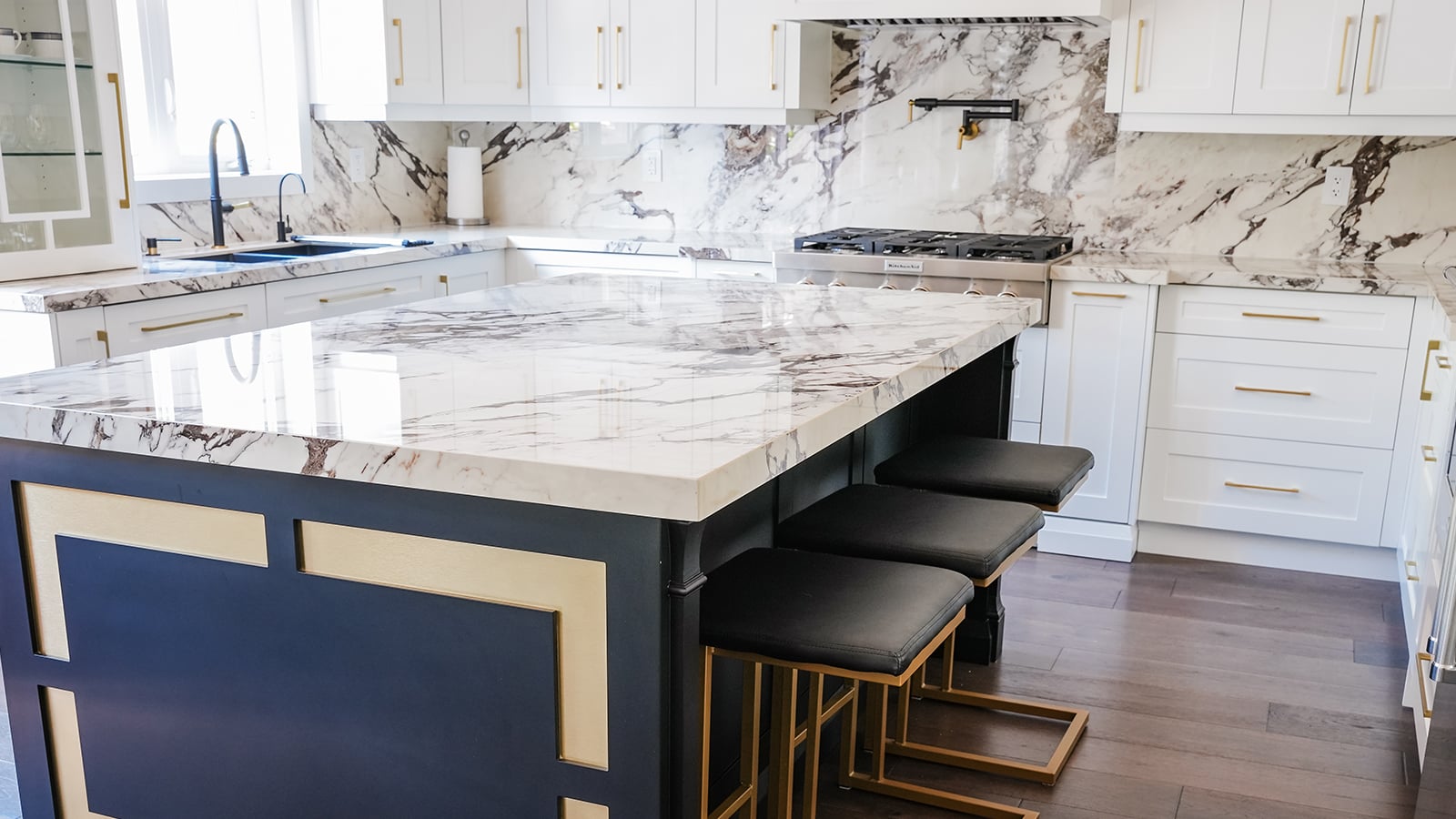
Every month someone asks us to quote a custom kitchen and then asks, quietly, whether they should just go to IKEA. It is a fair question and it deserves a straight answer rather than a sales one. Flat-pack is a genuinely good product for some rooms. Custom is a genuinely better product for others. The difference is not snobbery; it is fit, materials, hardware and what happens to the gaps.
What “custom” means at our workshop
Custom cabinets are built to your room’s measurements in our Mississauga workshop. A base run is exactly the width of your wall. A tall unit goes to your ceiling, not to a catalogue height. The fridge panel is cut for the fridge you own. Drawer banks are the width that makes sense for the pots you have. Doors and drawer fronts are made and finished to the sample you approved and installed by the crew that built the boxes.
What flat-pack means
IKEA’s system (and its competitors’) is a set of fixed-width modules, typically stepping in 3-inch increments, in a defined range of heights and depths, with a catalogue of fronts in a defined range of finishes. You design within those constraints, the boxes arrive flat, and someone — you or an installer — assembles and hangs them. Where the modules do not meet the wall, a filler strip covers the gap. Where the ceiling is higher than the tallest module, there is a space above the uppers. The boxes are melamine-faced particleboard; the hinges and runners are good, and better than many builders’ grade cabinets.
Where the money goes
Fit. A standard 10-by-10 room with an 8-foot ceiling and a standard 30-inch range is what flat-pack is designed for, and it fits well. A 1960s Cooksville bungalow with a bulkhead, a window that is not centred and a 33-inch gap where a 36-inch range wants to live is where fillers and compromises start. Custom boxes are the fillers.
Materials. Our boxes can be built in plywood or furniture-grade board to suit the budget; doors in painted MDF, laminate, thermofoil or wood veneer. Flat-pack boxes are particleboard throughout, which is fine in a dry kitchen and less fine under a sink that has ever leaked.
Hardware. This is where flat-pack is honestly good: soft-close hinges and runners are standard. Custom lets you choose heavier full-extension runners for deep drawers and specific interior fittings per drawer, but the baseline is closer than people expect.
Finish. Flat-pack fronts come in the finishes the catalogue offers this year. Custom doors are finished to your sample, in the colour you chose, and can be refinished later.
Install. Flat-pack is priced without the installer. By the time a competent installer has assembled, levelled, scribed fillers, cut panels and hung the doors, the installed total has moved a long way from the sticker. Custom is quoted installed, by the people who built it.
When IKEA is the right call
- A rental unit or a house you are selling within a couple of years.
- A standard condo or builder kitchen with standard appliances and an 8-foot ceiling.
- A tight budget where new cabinets must happen now and a countertop later.
- You enjoy assembling things and have the weekends to do it.
We will say so on the measure visit. A contractor who cannot name a kitchen where flat-pack is the better answer is not giving you advice.
When custom is the right call
- The room is not a box: bulkheads, odd widths, high ceilings, a window off-centre.
- You have already chosen appliances with non-standard dimensions, or a panel-ready fridge.
- You want a specific door profile or finish, or a kitchen that matches an older house.
- Storage density matters: drawers where flat-pack gives you doors, a pantry pull-out sized to the gap beside the fridge.
- You want one team responsible for the boxes, the doors and the install.
The honest cost picture
Our own cabinet ranges are published once the operator confirms them in writing; the market context for a full kitchen is in the Mississauga cost guide. The pattern is consistent: the gap between an installed flat-pack kitchen and custom boxes is real but smaller than the sticker suggests, and it buys fit you can see every time you open a drawer.
Still deciding? Read refacing vs replacing first — half the kitchens we measure need neither. Otherwise, see what custom cabinets involve or request a quote.
Frequently asked questions
Is a custom kitchen worth it over IKEA?
When the room is not a standard shape, the ceiling is high, the appliances are already chosen, or you want a specific door finish, yes — the price gap buys fit and finish you cannot get from fixed modules. For a rental or a standard condo kitchen, flat-pack often is the smart money.
How much more do custom cabinets cost than IKEA?
Less than the sticker gap suggests once you add the installer, fillers, upgraded hardware and panels to the flat-pack total. Our own ranges are published once the operator confirms them; the market context is in our Mississauga cost guide.
Can you install IKEA cabinets with custom doors?
Some shops do. We build the boxes and the doors because a box made to the wall removes the fillers that make a flat-pack kitchen look flat-pack.
We will tell you if IKEA is the better call for your room.
Get a written, itemised quote with a 3D design — no obligation.
Ask about custom cabinets